

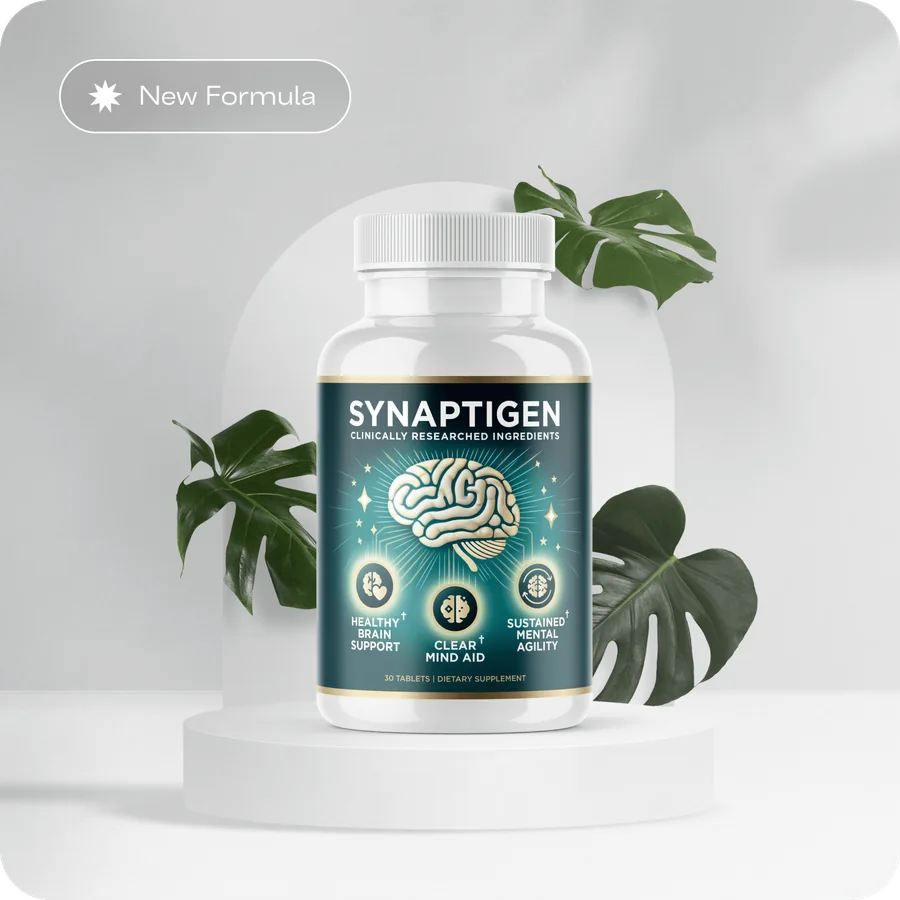
Synaptigen is sold as a 30-tablet bottle with a one-tablet serving.
Quick verdict
Synaptigen has a short, fully printed label: inulin 100 mg, a 20 mg probiotic blend at 3.5 billion CFU at manufacture, and Streptococcus salivarius 20 mg per tablet. The transparency is better than a large proprietary botanical blend, but the formula is thin. The inulin dose is 0.1 g, far below the gram doses used in most prebiotic research. The CFU count is not divided by strain and is not guaranteed at expiry. None of the strains has an established memory or dementia treatment dose. Synaptigen may be a small daily probiotic; it is not a proven cognitive supplement.
Text offer and label checked Oct 29, 2026 · No prices shown · 180-day refund terms
Table of contents
The full Synaptigen label
These are the amounts printed on the Supplement Facts panel for a one-tablet serving. The label has three active entries and four excipients. There is no large proprietary botanical blend.
| Ingredient | Amount per tablet | What the label tells you |
|---|---|---|
| Inulin powder Chicorium intybus, chicory root | 100 mg | A soluble prebiotic fibre. The amount is printed, but it is far below the gram doses used in most prebiotic studies. |
| Proprietary probiotic blend Lactobacillus paracasei, Lactobacillus reuteri, Bifidobacterium lactis BL-04 | 20 mg 3.5 billion CFU at manufacture | Three species share one 20 mg blend. Only one strain code is given. CFU are not divided by strain and are not guaranteed at expiry. |
| Streptococcus salivarius | 20 mg | An oral probiotic species. The label does not state a CFU count, strain code or extract identity for this entry. |
| Tricalcium phosphate | Excipient | A calcium salt used as a filler and flow agent. It is not part of the memory claim. |
| Microcrystalline cellulose, natural strawberry flavour, peppermint essential oil | Excipients | Tablet fillers and flavourings. Peppermint oil can cause reflux or mouth irritation in sensitive people. |
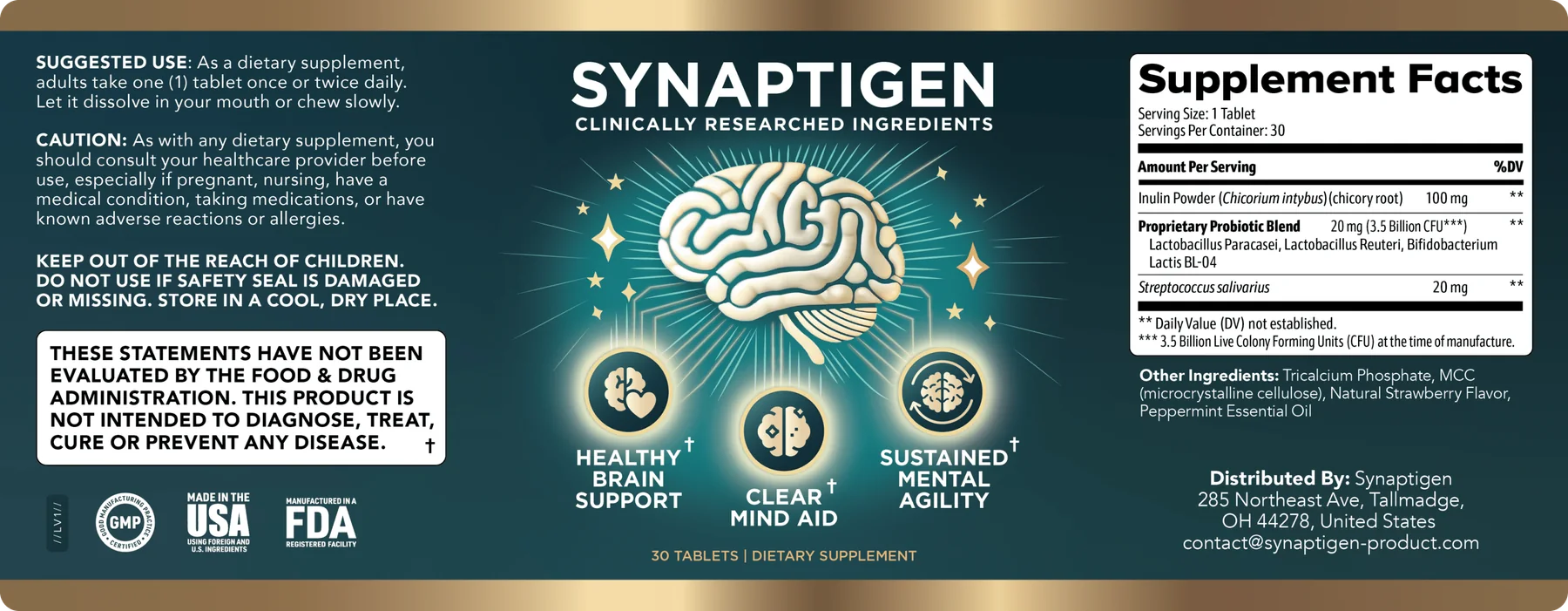
The published Supplement Facts panel. Three active entries, four excipients and no large hidden botanical blend.
Serving size and supply
One tablet is a serving, and one bottle contains 30 tablets. At the labelled dose, a bottle is a 30-day supply. The official offer shows 2-bottle, 3-bottle and 6-bottle packages, which correspond to roughly 60, 90 and 180 days if you take one tablet daily.
Do not assume that taking two tablets doubles the benefit. The label directs one tablet. Doubling would increase the inulin to 200 mg, still far below research doses, and would double the cost per day without fixing the missing strain detail or the lack of a product-specific trial. If you are considering a different dose, ask the seller or a clinician first.
Inulin 100 mg
Inulin is a soluble fibre found in chicory root, onions, garlic and other plants. It is a prebiotic, meaning it can feed certain gut bacteria. The evidence for prebiotic effects is real, but it is dose-dependent. Human studies commonly use several grams per day, often 5 g or more, to shift the microbiome or improve bowel habit.
Synaptigen contains 100 mg, which is 0.1 g. That is roughly one-fiftieth of a 5 g dose. It may be enough to appear on a label, but it is not a dose that has been shown to produce a meaningful prebiotic effect. The small amount also makes it unlikely to cause the gas and bloating that higher inulin doses can cause, but that is a tolerability point, not an efficacy point.
Inulin is not a memory ingredient. Some research explores the gut-brain axis and the effect of fibre on inflammation, but there is no established inulin dose for preventing or treating memory loss. The 100 mg entry should be read as a token prebiotic, not as the active core of a cognitive formula.
The 20 mg probiotic blend
The blend contains Lactobacillus paracasei, Lactobacillus reuteri and Bifidobacterium lactis BL-04. The total is 20 mg with 3.5 billion CFU at the time of manufacture. Probiotic effects are strain-specific. A genus or species name is not enough to transfer research from one product to another.
| Organism | What it is studied for | What the Synaptigen label does not show |
|---|---|---|
| Lactobacillus paracasei | Some strains have been studied for gut comfort, immune outcomes and, in small trials, mood or stress. Results vary by strain and population. | No strain code, no CFU share and no memory trial of this blend. |
| Lactobacillus reuteri | Some strains have been studied for infant colic, gut health, oral health and immune outcomes. It is not an established cognitive ingredient. | No strain code and no CFU share. The species name alone does not identify the studied organism. |
| Bifidobacterium lactis BL-04 | BL-04 has been studied mainly for immune and respiratory outcomes in healthy adults, and for gut-related endpoints. | The CFU contribution is not stated. A strain code is present, which is better than none, but the dose is not separated. |
Probiotic cognition trials do exist, but they are small, short and inconsistent. Reviews often describe the results as promising rather than established. They do not show that this three-species blend at 3.5 billion CFU improves memory, focus or mental clarity. The gut-brain axis is a legitimate research area; it is not a licence to claim that a tablet repopulates the brain.
Streptococcus salivarius 20 mg
Streptococcus salivarius is a bacterium that colonises the mouth and upper respiratory tract. Some strains, such as K12 and M18, have been studied for oral-health and upper-respiratory outcomes. The Synaptigen label does not name a strain or a CFU count for this entry, so the buyer cannot tell which organism was used or whether it is viable.
There is no established role for S. salivarius in memory or dementia. It is the least relevant ingredient to the product's main marketing claim. Its presence may make sense in an oral probiotic, but it does not strengthen a cognitive formula.
Other ingredients
- Tricalcium phosphate: a calcium salt used as a filler and flow agent. It contributes a small amount of calcium, but it is not a therapeutic ingredient here.
- Microcrystalline cellulose: a plant-derived filler that gives the tablet structure.
- Natural strawberry flavour: a flavouring. Anyone with a strawberry allergy should check the source with the seller.
- Peppermint essential oil: a flavouring that can cause heartburn, nausea or mouth irritation in sensitive people. It may worsen reflux.
The label does not list gelatin, so the tablet may be suitable for some vegetarians, but "natural flavour" and the tablet coating can have animal-derived components. If vegan status matters, ask the seller for written confirmation rather than relying on the absence of gelatin.
What is not in Synaptigen
Synaptigen does not contain the ingredients most often studied for nerve or cognitive health: omega-3 DHA, vitamin B12, vitamin D, magnesium, curcumin, creatine or alpha-lipoic acid. That is not automatically a flaw, because no single supplement has been proven to prevent dementia, and a short formula can be easier to assess.
But it matters for the marketing. The sales page frames Synaptigen as a memory and brain-health product. The formula is a small probiotic with a token prebiotic. There is no ingredient with a strong, product-specific memory evidence base. A buyer who wants a general probiotic may find the label acceptable. A buyer who expects a cognitive treatment is looking at the wrong category.
CFU, strains and expiry
The label says "3.5 Billion Live Colony Forming Units (CFU) at the time of manufacture." That wording is important. It is not a guarantee that the tablet will contain 3.5 billion viable organisms at expiry. Storage temperature, moisture and time can reduce the count.
The CFU are also not divided among the three species. A 20 mg blend at 3.5 billion CFU could be weighted heavily toward one organism. Without per-strain counts, a buyer cannot compare the product with a clinical study that used a specific strain at a specific dose. A stronger label would show strain codes and CFU for each strain, plus a count guaranteed through expiry.
Who it may suit, and who should skip it
May suit
- Adults who want a simple, fully printed probiotic and understand that the evidence is general, not memory-specific.
- Buyers who prefer a short label over a large proprietary botanical blend.
- People who have already discussed memory concerns with a clinician and are not using the tablet as a substitute for assessment.
Skip or ask first
- Anyone who is immunocompromised, critically ill, has a central venous catheter or has short bowel syndrome.
- Anyone with severe reflux or a peppermint or strawberry allergy.
- Anyone looking for a proven treatment for memory loss, dementia or Alzheimer's disease.
- Anyone who wants per-strain CFU and expiry data before buying.
Probiotics are usually well tolerated, but the risk depends on the person and the clinical setting. For the full safety detail, read our Synaptigen side effects guide. For the seller and refund findings, read the full Synaptigen review.
Check the current Synaptigen label
Confirm the formula, package size and refund terms on the official page before you order.
Visit official offerFrequently asked questions
What are the Synaptigen ingredients?
Each one-tablet serving lists inulin 100 mg, a 20 mg probiotic blend of Lactobacillus paracasei, Lactobacillus reuteri and Bifidobacterium lactis BL-04 at 3.5 billion CFU at manufacture, and Streptococcus salivarius 20 mg. Other ingredients are tricalcium phosphate, microcrystalline cellulose, natural strawberry flavour and peppermint essential oil.
How much inulin is in Synaptigen?
The label lists 100 mg of inulin per tablet. That is 0.1 g. Prebiotic research often uses several grams per day, so 100 mg is far below the doses used in most human studies.
How many CFU are in Synaptigen?
The label states 3.5 billion CFU at the time of manufacture for the 20 mg probiotic blend. It does not give CFU per strain or a guaranteed count at expiry.
Does Synaptigen contain a strain for memory?
No strain in the product has an established memory or dementia treatment dose. The blend contains species studied mainly for gut, immune, oral or respiratory outcomes. Probiotic cognition research exists, but it is strain-specific, short-term and inconsistent, and it has not tested this finished formula.
Is Synaptigen vegan?
The label lists no gelatin, but the tablet contains tricalcium phosphate, microcrystalline cellulose, natural strawberry flavour and peppermint essential oil. Buyers should confirm the tablet coating and flavouring sources with the seller if vegan status matters.
Can I take two Synaptigen tablets to double the dose?
The label directs one tablet per serving. Do not double the dose without asking the seller or a clinician. More tablets would not fix the missing strain detail or the lack of a product-specific trial, and it would increase the cost per day.
References
- Synaptigen - official text offer
- Synaptigen - Supplement Facts label image
- Synaptigen - seller-cited reference list
- PubMed search - "Synaptigen"
- PubMed search - probiotics and cognition reviews
- PubMed search - inulin, prebiotics and cognition
- NCCIH - Probiotics: what you need to know
- NIH ODS - Probiotics fact sheet for health professionals
- FDA - Information for consumers on using dietary supplements