

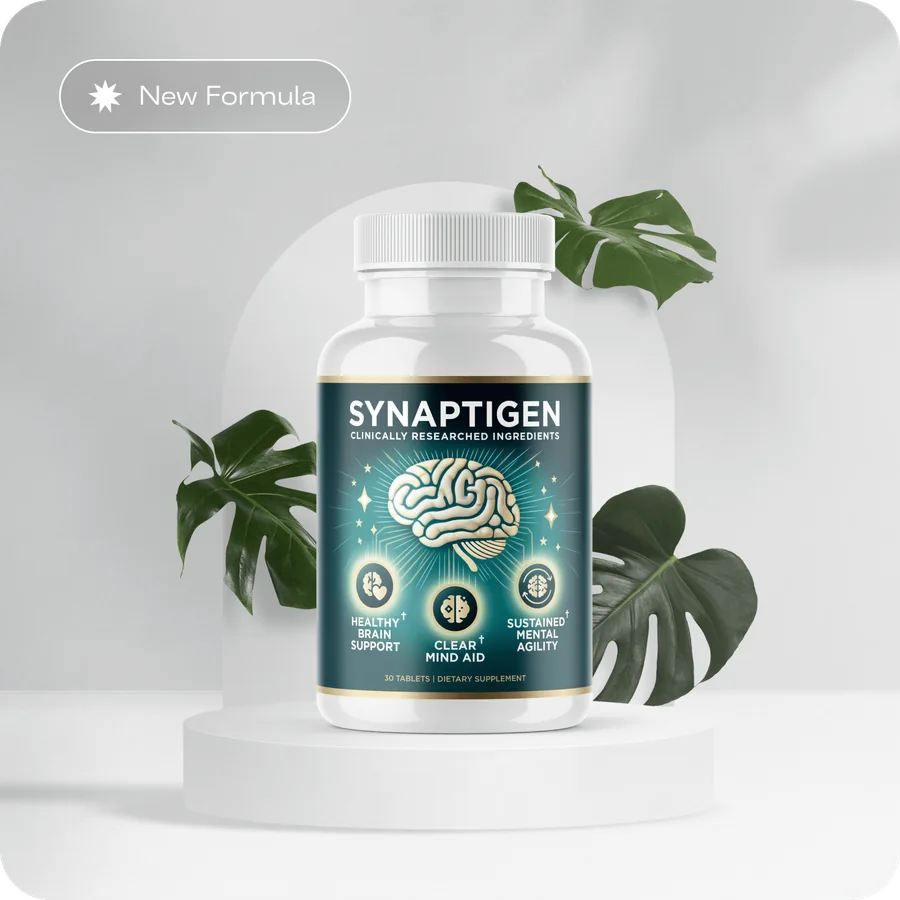
Synaptigen is sold as a 30-tablet bottle. The label lists one tablet as a serving, so one bottle is a 30-day supply at the labelled dose.
Quick verdict
Synaptigen is a 30-tablet probiotic and prebiotic supplement marketed for memory, focus and mental clarity. The label is short and easy to read, but the formula is thin: 100 mg of inulin, a 20 mg probiotic blend at 3.5 billion CFU at manufacture, and 20 mg of Streptococcus salivarius. The sales story — that sugar coats neurons and probiotics travel to the brain to repair them — is not supported by established biology. The bigger problem is the documentation. The official reference page cites papers on L-arginine, liver fat, pancreatic disease, guarana, gymnema, carnitine and capsaicin, none of which are in this product, and it links labels for two other supplements. Synaptigen may be a small daily probiotic. It is not a proven memory treatment.
Text offer checked Oct 29, 2026 · 2, 3, or 6 bottles · 180-day refund terms
Table of contents
- Evidence scorecard
- Synaptigen at a glance
- What is Synaptigen?
- Synaptigen ingredients and doses
- What the evidence supports
- Side effects and interactions
- Synaptigen reviews and complaints
- Package sizes and supply
- Refund terms
- Who it may suit, and who should skip it
- Frequently asked questions
- How we researched this review
- References
Synaptigen: what checked out and what did not
All five active entries have amounts, but the formula contains only three functional ingredients and a small prebiotic dose.
A PubMed search for “Synaptigen” returned no product trial.
Probiotic cognition research is strain-specific and preliminary; none of it tested this formula or this dose.
Inulin is 100 mg. Prebiotic studies usually use grams per day, not a tenth of a gram.
The official reference page cites ingredients that are not in Synaptigen and links two unrelated product labels.
The FAQ says the formula is designed for “all ages and medical conditions,” which is too broad for any probiotic.
The window is long, but the refund page tells buyers to use the product for six months before deciding.
Best for: adults who want a simple daily probiotic and understand that Synaptigen has no demonstrated memory benefit, no product trial, and a mismatched reference list.
Not for: anyone investigating memory loss, confusion or dementia; people who are immunocompromised, critically ill, have a central line or short bowel, or take immunosuppressants; and anyone who will not check the strain list with a clinician.
Synaptigen at a glance
| Question | What we found |
|---|---|
| What is it? | Label checked A 30-tablet probiotic and prebiotic supplement marketed for memory and focus; one tablet is a serving |
| Are the doses listed? | Partly Inulin 100 mg, probiotic blend 20 mg (3.5 billion CFU at manufacture), S. salivarius 20 mg; no individual CFU counts for the three strains |
| Is there a trial of Synaptigen? | Not found A PubMed search returned no results for the finished product |
| Package sizes | Seller offer 2, 3, or 6 bottles; US shipping was listed as free |
| What is the refund promise? | 180 days From delivery; return all bottles and the packing slip; buyer pays return shipping |
| Main concern? | Evidence gap The brain-sugar story is unsupported, the prebiotic dose is tiny, and the official references do not match the formula |
“Label checked” means we compared the published panel with the amounts discussed on the sales page. Seller claims are statements on official pages, not independent findings.
What is Synaptigen?
Synaptigen is a direct-to-consumer supplement sold in a 30-tablet bottle. The label says adults can take one tablet once or twice daily and let it dissolve in the mouth or chew it slowly. The sales page recommends one tablet before bed, so the practical supply is 30 days at the lower dose and 15 days at the upper dose. The label calls it a tablet rather than a capsule, and the formula is built around a small prebiotic dose, three probiotic strains and Streptococcus salivarius.
The marketing presents Synaptigen as a way to “clear sugar buildup from neurons” and support memory “well into old age.” That is a much bigger claim than the label supports. The formula does not contain a drug, a vitamin or a botanical with an established memory-treatment dose. It contains probiotic bacteria and a prebiotic fibre. Those ingredients can affect the gut microbiome, but the gut-brain axis is an active research area, not a proven route for repairing memory with a 30-tablet bottle.
The sales page also says the formula is “designed for all ages and medical conditions” and that its ingredients have been “proven safe in clinical trials.” Both statements are overbroad. Probiotics are generally well tolerated, but they are not risk-free for people who are immunocompromised or critically ill, and the label itself does not make an all-ages claim. The product is sold through a DigiStore24 checkout as a one-time purchase, with no subscription stated.
If you are comparing products in this cluster, our Vertigenics review covers a balance formula, our Claritox Pro review covers a nearly identical balance formula, and our Quietum Plus review covers a hearing-focused blend.
Synaptigen ingredients and doses
These are the amounts printed on the Supplement Facts panel for a one-tablet serving. The label is short. That makes it easy to audit, but it also shows how little is in the formula beyond the probiotic cultures.
| Ingredient | Amount per tablet | What the public evidence supports |
|---|---|---|
| Inulin powder Chicorium intybus, chicory root | 100 mg | Low dose A soluble prebiotic fibre. Human studies often use several grams per day to change the microbiome; 100 mg is a small fraction of those doses. It is unlikely to do much on its own. |
| Proprietary probiotic blend Lactobacillus paracasei, Lactobacillus reuteri, Bifidobacterium lactis BL-04 | 20 mg 3.5 billion CFU at manufacture | Strain-specific Probiotic effects depend on the strain, dose and viable count at the time you take it. BL-04 has been studied mainly for immune and respiratory outcomes. We found no memory trial of this blend. |
| Streptococcus salivarius | 20 mg | Indirect An oral probiotic commonly studied for oral-health and upper-respiratory outcomes. It is not an established cognitive ingredient, and the label does not state a CFU count for this strain. |
| Tricalcium phosphate | Excipient | Listed A calcium salt used as a filler and flow agent. It is not the focus of the memory claim. |
| Microcrystalline cellulose, natural strawberry flavour, peppermint essential oil | Excipients | Listed Tablet fillers and flavourings. Peppermint oil can cause reflux or mouth irritation in sensitive people. |
The label says “3.5 Billion Live Colony Forming Units (CFU) at the time of manufacture.” That wording matters. It is not a guarantee of potency at expiry, and the three strains are grouped into a single 20 mg blend, so you cannot see how the CFU are divided. A 3.5 billion count is not automatically low, but it is toward the lower end of the range used in many commercial probiotics and much lower than the counts used in some clinical studies.
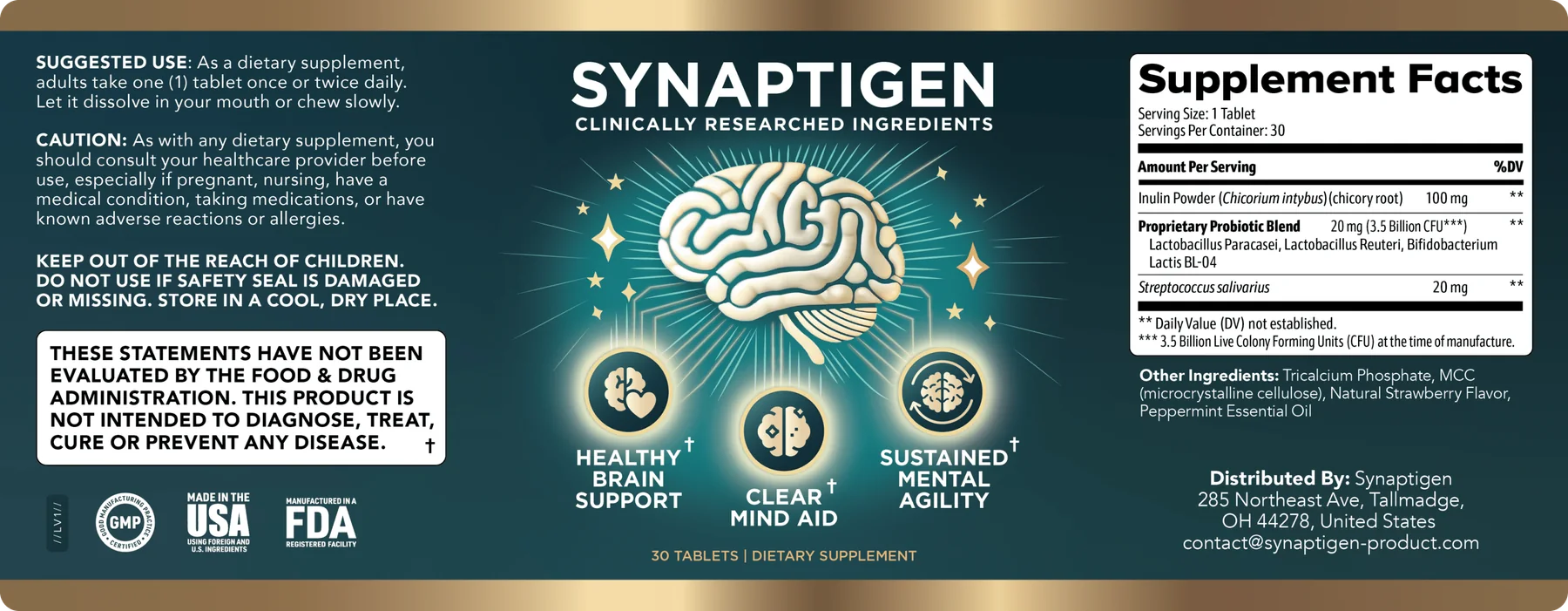
The published Supplement Facts panel. The formula has three active entries, plus excipients. The label does not break out CFU by strain or guarantee a count at expiry.
For the dose-by-dose breakdown, including what the strain names do and do not tell you, read our full Synaptigen ingredients guide. For the interaction and safety detail, see Synaptigen side effects.
What the evidence supports, and what it does not
The strongest part of Synaptigen is that it is simple. A buyer can see every active ingredient and every amount. There is no 900 mg proprietary blend hiding ten botanicals. The weakness is that simplicity cuts both ways: there is very little in the formula to support the size of the claim.
The sales page’s central theory is that the brain hoards sugar, sugar coats neurons, and probiotics then “populate the brain” and teach it to refuse excess sugar. That is not how oral probiotics are understood to work. Orally ingested bacteria are not established to colonise the brain, and dementia is not simply a layer of sugar on neurons. The phrase “Type 3 diabetes” appears in the research literature as a hypothesis about insulin resistance and Alzheimer’s disease; it is not an accepted diagnosis, and it does not mean that a probiotic tablet can reverse memory loss.
The ingredient evidence is early and indirect. Probiotic cognition trials exist, but they are small, short, strain-specific and often conducted in healthy adults or people with mild cognitive impairment. Reviews commonly call the results promising but inconsistent. They do not show that L. paracasei, L. reuteri and B. lactis BL-04 at this combined dose improve memory. S. salivarius is even further away from the claim: it is studied mainly for the mouth and upper respiratory tract, not for cognition.
The inulin dose is the clearest dose problem. Prebiotic research typically uses grams per day — often 5 g or more — to shift the gut microbiome. Synaptigen contains 100 mg, which is 0.1 g. That is roughly one-fiftieth of a 5 g dose. It may be enough to appear on a label, but it is not a dose that has been shown to produce a meaningful prebiotic effect.
The official reference page is the most serious credibility problem. It lists papers on L-arginine and blood pressure, liver fat and pancreatic disease, guarana, gymnema, carnitine, capsaicin and other topics that are not Synaptigen ingredients. It also links labels for Somnogenix and Rejuvex, two unrelated products. We cannot tell whether the page was copied from another offer or simply left unfinished. Either way, it does not document the formula being sold. A PubMed search for “Synaptigen” returned no product trial.
Bottom line: Synaptigen is a small probiotic supplement with a clear label and a large marketing story. The story is not supported by the formula, the doses or the reference list. It is not a proven memory treatment and should not be used instead of an assessment for memory loss.
Synaptigen side effects and interactions
The sales page calls the formula safe for “all ages and medical conditions.” That is not a standard any supplement can meet. Probiotics are usually well tolerated, but the risk depends on the person, the strain and the clinical setting.
- Gas and bloating. Inulin and probiotic bacteria can cause temporary gas, bloating, cramping or loose stools, especially in the first week.
- Infection risk in vulnerable people. Probiotics can cause invasive infection in people who are immunocompromised, critically ill, have a central venous catheter, or have short bowel syndrome. Ask a clinician before using any probiotic in those settings.
- Allergy. The tablet contains natural strawberry flavour and peppermint essential oil. Anyone with a relevant allergy or severe reflux should check the excipients.
- No expiry guarantee. The CFU count is stated at manufacture. Storage conditions and time can reduce the live count, and the label does not give a count at expiry.
- Memory symptoms need assessment. Do not use a probiotic to explain away progressive memory loss, confusion, personality change or difficulty with daily tasks. Those symptoms deserve a clinical work-up.
Synaptigen reviews and complaints
There is search demand for Synaptigen complaints, but we did not find a reliable public complaint dataset that could be verified. We are not going to invent customer quotes or present anonymous posts as fact. The concerns below are the ones a buyer can actually check.
- The reference page does not match the product. It cites L-arginine, liver fat, pancreatic disease, guarana, gymnema, carnitine and capsaicin, none of which are Synaptigen ingredients. It also links labels for Somnogenix and Rejuvex.
- The brain-sugar story is not established. “Type 3 diabetes” is a research hypothesis, not a diagnosis, and oral probiotics are not established to colonise the brain or clear neuronal sugar.
- The prebiotic dose is tiny. Inulin is 100 mg. Most prebiotic research uses gram doses, so the label amount is unlikely to produce the effect the marketing implies.
- The CFU count is at manufacture. The label does not guarantee 3.5 billion live organisms at expiry, and it does not break the count down by strain.
- The “all ages and medical conditions” claim is overbroad. Probiotics carry real risks in immunocompromised and critically ill people, and the label itself does not support that blanket claim.
- The refund advice can consume the refund window. The refund page tells buyers to use the product for at least six months before deciding, while the window is 180 days from delivery. Waiting that long may leave little time to return it.
- The social proof is unverifiable. The page displays a “12,643 reviews” count and a “96% of customers order 6 bottles” line, but we found no public review dataset or methodology behind those numbers.
- The directions vary slightly. The label says one tablet once or twice daily; the sales page recommends one tablet before bed. That affects how long a bottle lasts.
None of this proves that Synaptigen is unsafe. It does mean that the strongest claims come from marketing, not from a study of the product, and that the dose and reference problems are visible without a lab test.
Synaptigen package sizes and supply
The text offer linked from this review showed 2-bottle, 3-bottle and 6-bottle packages on 29 October 2026. One tablet is a serving, so the estimates below assume one tablet per day; taking two tablets per day halves them.
| Package | Approximate supply |
|---|---|
| 2 bottles | 60 days |
| 3 bottles | 90 days |
| 6 bottles Largest pack | 180 days |
US shipping was listed as free on the offer page; international shipping may apply. The six-bottle package showed three digital bonuses. The page says purchases are one-time, with no autoship. Confirm the package, shipping terms and currency on the order form before paying.
The offer starts at two bottles rather than one. If you only want a short trial, the smallest package is still a two-bottle purchase.
Check the current Synaptigen label and package options
The offer we checked included 2-, 3- and 6-bottle packages with free US shipping. Confirm the package, shipping terms and 180-day refund before you order.
Visit official offerSynaptigen refund terms
The official refund page gives buyers 180 days from the day the order is delivered. To request a refund, email [email protected] with “Refund Request” in the subject line, return all bottles — empty or not — and include a note with your name, email and order ID if possible, plus the packing slip. The buyer pays return shipping. The listed address is 285 Northeast Ave, Tallmadge, OH 44278, United States.
The page says refunds are processed within 5–10 days after the package arrives. Order support is handled through DigiStore24. The label lists [email protected]. We did not find a public phone number on the pages we checked.
| Source | What it says |
|---|---|
| Official refund page | 180 days from delivery; return all bottles, empty or not; buyer pays return shipping; 5–10 days to process after receipt |
| Refund page advice | Use the product for at least six months before deciding whether to request a refund |
| Label | One tablet once or twice daily; 30 tablets per bottle |
| Checkout | Confirm the guarantee, shipping charge and package shown on your order form |
The timing is the main concern. A 180-day window sounds generous, but the same page tells buyers to give the product six months before reaching a conclusion. If you follow that advice, you may reach the end of the refund period before you have a fair chance to decide. If you order, ask support to confirm in writing: the exact guarantee window for your order, whether shipping is refundable, whether opened bottles are accepted, and the current return address. Save the reply.
Who Synaptigen may suit, and who should skip it
Best for
- Adults who want a simple daily probiotic and accept that it has no demonstrated memory benefit.
- Readers who will check the strains and excipients with a pharmacist or clinician before starting.
- Buyers who will confirm the total, shipping charge and refund terms in writing before ordering.
Not for
- Anyone with progressive memory loss, confusion, personality change or difficulty with daily tasks. Get a clinical assessment.
- People who are immunocompromised, critically ill, have a central line or short bowel, or take immunosuppressants.
- Anyone pregnant or nursing, under 18, or with a serious medical condition, unless a clinician has approved the specific strains.
If you are looking for something to treat memory loss, start with a clinician rather than a supplement. The cause matters, and treatable conditions should not be managed by trial and error.
Is Synaptigen still worth a look?
Only if you want a small daily probiotic and accept that it is not a proven memory treatment. If that trade-off fits, confirm the 180-day terms and the package total before ordering.
Visit official offerFrequently asked questions
Is Synaptigen legit?
Synaptigen is a real 30-tablet probiotic and prebiotic product sold through a DigiStore24 checkout. It is not a proven memory treatment. We found no published clinical trial of the finished formula, and the sales page’s explanation that probiotics repopulate the brain is not supported by established biology.
Does Synaptigen work for memory?
We found no trial of Synaptigen and no evidence that this specific combination improves memory or prevents dementia. Probiotic research is strain-specific, mostly short-term and often indirect. The product’s inulin dose is 100 mg, far below the gram doses used in most prebiotic research.
What are the ingredients in Synaptigen?
Each one-tablet serving lists inulin 100 mg, a 20 mg proprietary probiotic blend of Lactobacillus paracasei, Lactobacillus reuteri and Bifidobacterium lactis BL-04 at 3.5 billion CFU at manufacture, and Streptococcus salivarius 20 mg. Other ingredients are tricalcium phosphate, microcrystalline cellulose, natural strawberry flavour and peppermint essential oil.
What are the side effects of Synaptigen?
Gas, bloating, cramping and loose stools are the most likely short-term effects. Probiotics can cause invasive infection in people who are immunocompromised, critically ill, have a central line or have short bowel syndrome. The tablet also contains strawberry flavour and peppermint oil, which can cause allergy or reflux in sensitive people.
What package sizes are available?
The official text offer showed 2-bottle, 3-bottle and 6-bottle packages. One tablet is a serving, so a bottle lasts about 30 days at one tablet daily; taking two tablets daily halves that. US shipping was listed as free on the offer page. The six-bottle package included three digital bonuses.
What is the Synaptigen refund policy?
The official refund page says buyers have 180 days from delivery. You must email [email protected] with “Refund Request” in the subject, return all bottles and the packing slip, and pay return shipping. The return address is 285 Northeast Ave, Tallmadge, OH 44278, United States. The same page advises using the product for at least six months before deciding.
Are the Synaptigen references reliable?
No. The official reference page lists papers on L-arginine, liver fat, pancreatic disease, guarana, gymnema, carnitine and capsaicin, none of which are Synaptigen ingredients. It also links labels for Somnogenix and Rejuvex. That is a serious documentation failure for a memory supplement.
Can Synaptigen prevent dementia?
No. There is no evidence that Synaptigen prevents Alzheimer’s disease or any other dementia. The “Type 3 diabetes” phrase is a research hypothesis, not a diagnosis, and it does not mean that a probiotic tablet can reverse or prevent memory loss. See a clinician for progressive cognitive symptoms.
Where can I buy Synaptigen?
The brand sells Synaptigen through direct-response offer pages and a DigiStore24 checkout. This review links to the text offer and may earn a commission. Confirm the seller, formula, package details, shipping terms and refund policy before paying.
How we researched this Synaptigen review
This review is documentation-based. We checked:
- the published Supplement Facts label image;
- the official text presentation, FAQ, contact, shipping, refund, terms and reference pages;
- the two-, three- and six-bottle package totals and the stated shipping rates;
- PubMed for “Synaptigen,” for probiotic cognition trials, and for inulin and Streptococcus salivarius;
- NCCIH and NIH Office of Dietary Supplements material on probiotics;
- National Institute on Aging material on Alzheimer’s disease and memory loss;
- FDA consumer information on dietary supplements.
We did not use vendor testimonials, star ratings or customer counts as evidence. We did not test the product or send it to a laboratory. “Not found” means that we did not find the material in the sources we checked; it is not proof that no such material exists.
Buyerlytic may earn a commission from the commercial link on this page. That does not change your purchase terms, and it did not determine the findings. Read the editorial methodology and affiliate disclosure.
References
- Synaptigen — official text offer
- Synaptigen — Supplement Facts label image
- Synaptigen — contact page and sales FAQ
- Synaptigen — refund policy and return address
- Synaptigen — shipping policy
- Synaptigen — seller-cited reference list
- PubMed search — “Synaptigen”
- PubMed search — probiotics and cognition reviews
- PubMed search — inulin, prebiotics and cognition
- PubMed search — Streptococcus salivarius and cognition
- NCCIH — Probiotics: what you need to know
- NIH ODS — Probiotics fact sheet for health professionals
- National Institute on Aging — What is Alzheimer’s disease?
- FDA — Information for consumers on using dietary supplements